I have two thoughts I keep coming back to. The first is that the LLM model is no longer the product. The second is that most people making decisions about AI are not asking the question that matters most: how do you maximise the value of an output token?
These two thoughts arrive at the same place. A frontier model is becoming a commodity. The leading models are converging on capability, the gap between releases is narrowing, and switching from one to another is increasingly a configuration change rather than a rebuild. If everyone can buy roughly the same engine, the engine is not where the advantage is. The advantage is in what you build around it.
For a while the conversation was dominated by which model topped which benchmark. That race still matters, but it is no longer where the differentiation sits for the people deploying AI inside a business. The model is now an input, an extraordinary one, but an input. The product is the system that turns that input into reliable, valuable work, again and again, inside a real workflow.
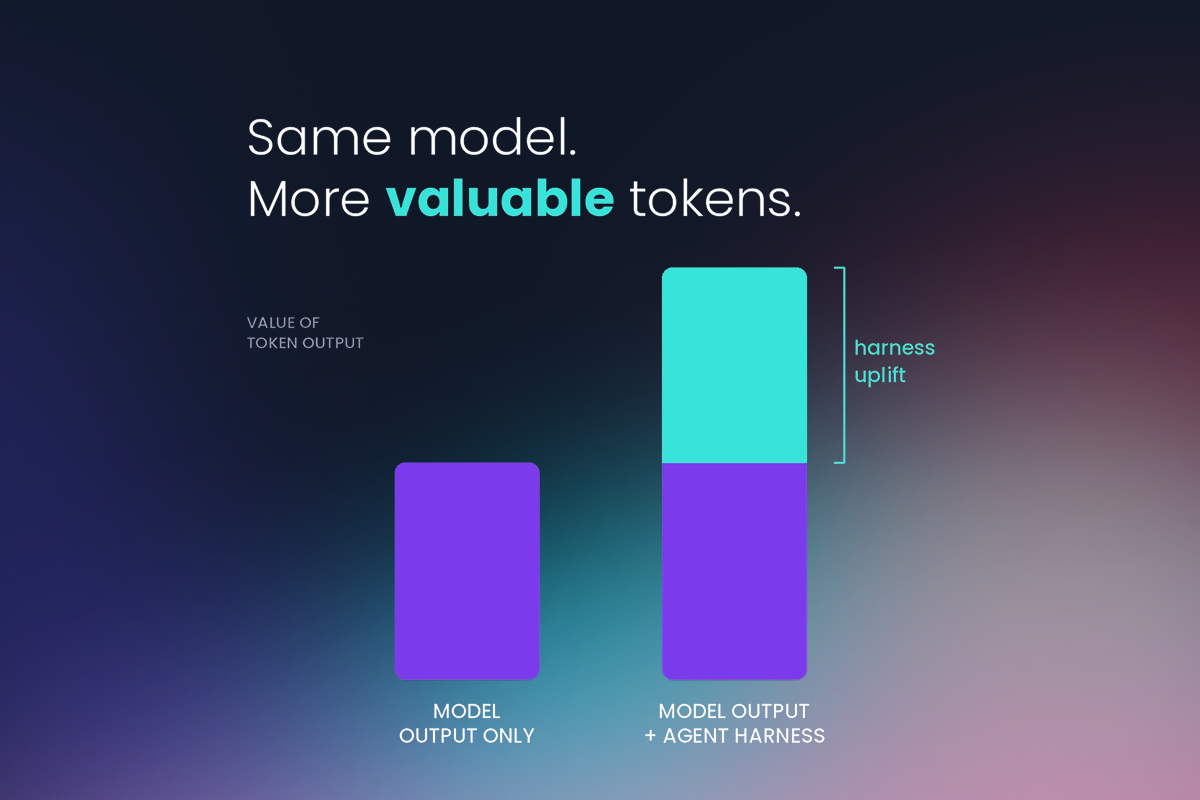
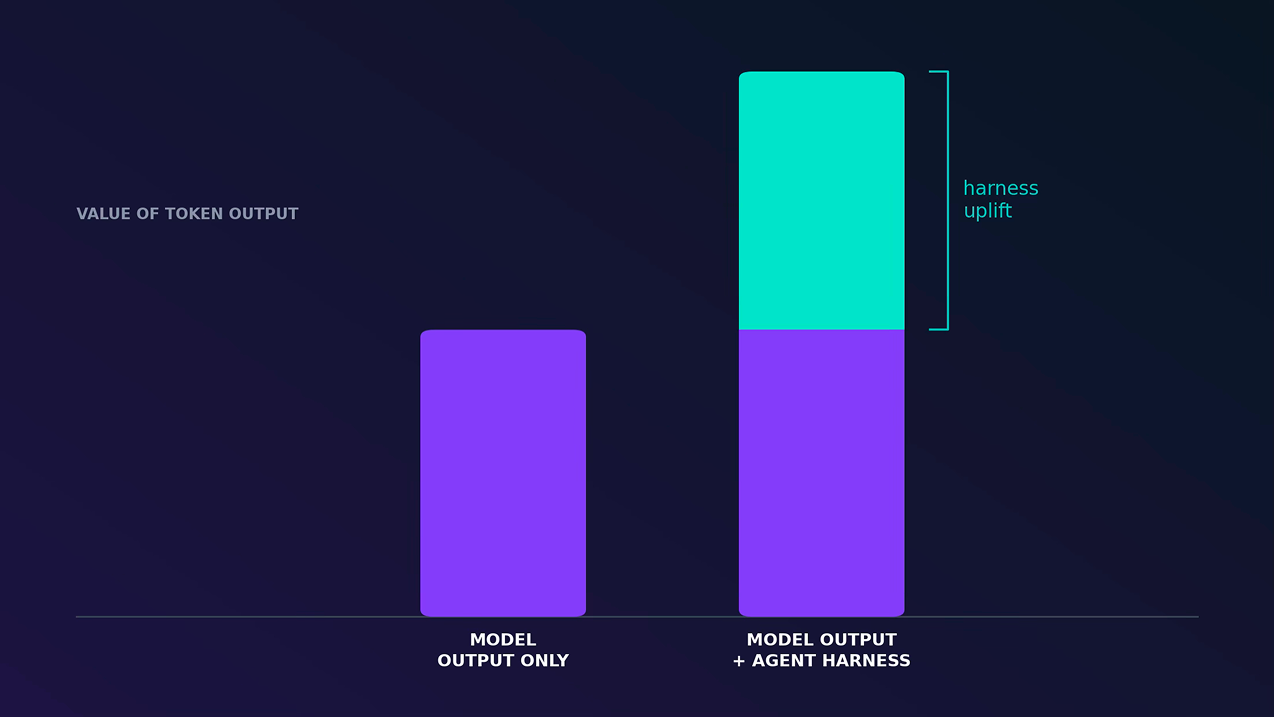
Same model. More valuable tokens.
A model produces tokens. On their own, those tokens are raw material, fluent text that may or may not be correct, grounded, or usable. What turns them into something an organisation can act on; a decision, a deliverable, a completed task is everything that surrounds the model. That surrounding layer is the agent harness, and it is where the value now lives. The same token, produced by the same model, is worth far more once it has been routed, grounded, checked, and put to work.
What an agent harness actually orchestrates.
The harness is the orchestration layer of an AI system. Getting it right is what compounds the value of every output token. It coordinates four things:
1. Tools. The model can reason, but it cannot act. The harness gives it the ability to call functions, run calculations, query a system, or draft a document and to use the results to reason further. A token that triggers the right tool call is worth more than a token that merely describes what should happen.
2. Agents. Complex work is rarely one prompt. The harness breaks a task into steps, assigns them, lets specialised agents check and challenge each other, and assembles the result. Coordination is what turns a clever answer into completed work.
3. Data. A model with no context produces plausible text. A model grounded in the right document, record, or policy at the right moment produces something true. The harness retrieves, filters, and feeds the relevant data so the output is anchored in reality rather than averages.
4. Systems. Output only has value when it lands somewhere. The harness connects to the systems where work actually happens, so a result becomes an updated record, a sent file, or a closed task rather than a paragraph someone still has to action.
Get these four right and the effect compounds. The output of a well-grounded tool call becomes the input to a better-reasoned next step, which lands cleanly in the right system. Get them wrong and you have a brilliant model producing confident, unusable text. The harness is the difference between a demo and a worker.
The piece the model makers cannot claim.
Here is the part that matters most. A key piece of maximising the value of an output token is the ability to orchestrate across multiple models. Different models are better at different things; one reasons well over long context, another is fast and cheap for routine steps, another is stronger at code or extraction. A good harness routes each step to the model best suited to it, and is never captive to a single provider.
This is something an OpenAI or an Anthropic cannot claim. They are, understandably, in the business of selling their own model, and their incentive is to keep you on their engine. A harness built to be model-agnostic has the opposite incentive: to use the best tool for each job, wherever it comes from, and to swap it out the moment something better appears. That neutrality is not a feature you can bolt on later, it is an architectural choice, and it is a genuine moat.
Where this leaves the buyer.
If the model is a commodity and the harness is where value compounds, then the question to ask of any AI system is no longer “which model does it use?” It is “how well does it orchestrate tools, agents, data and systems and across how many models?” That is what enriches the product, and that is what makes every token it produces worth more than the one before it.