Covecta's value proposition and our position in the market are evolving at pace. I wanted to share the journey we have been on, because the direction of travel matters for anyone building an AI strategy inside a Bank, Specialist Lender, Building Society or Credit Union.
Where we initially landed
We came to market offering agentic workflow capabilities for all of the work that sits outside your incumbent systems. Typically lending origination and servicing, and KYC/AML and compliance.
It has been very successful
- Clients were live in 12 weeks, either with or without integrations.
- Work is completed by agents alongside existing teams.
- There was no need to rip and replace a system.
- Innovation still moved forward, even under a technology freeze or a large-scale transformation programme.
Then a few things started happening
1. We were being pulled into deeper core workflows.
2. Clients started to ask what it would look like if we replaced an incumbent LOS or equivalent system.
3. Clients asked whether we could help them deploy entirely new business models
None of this came from a roadmap. It came from the market.
Strategic optionality
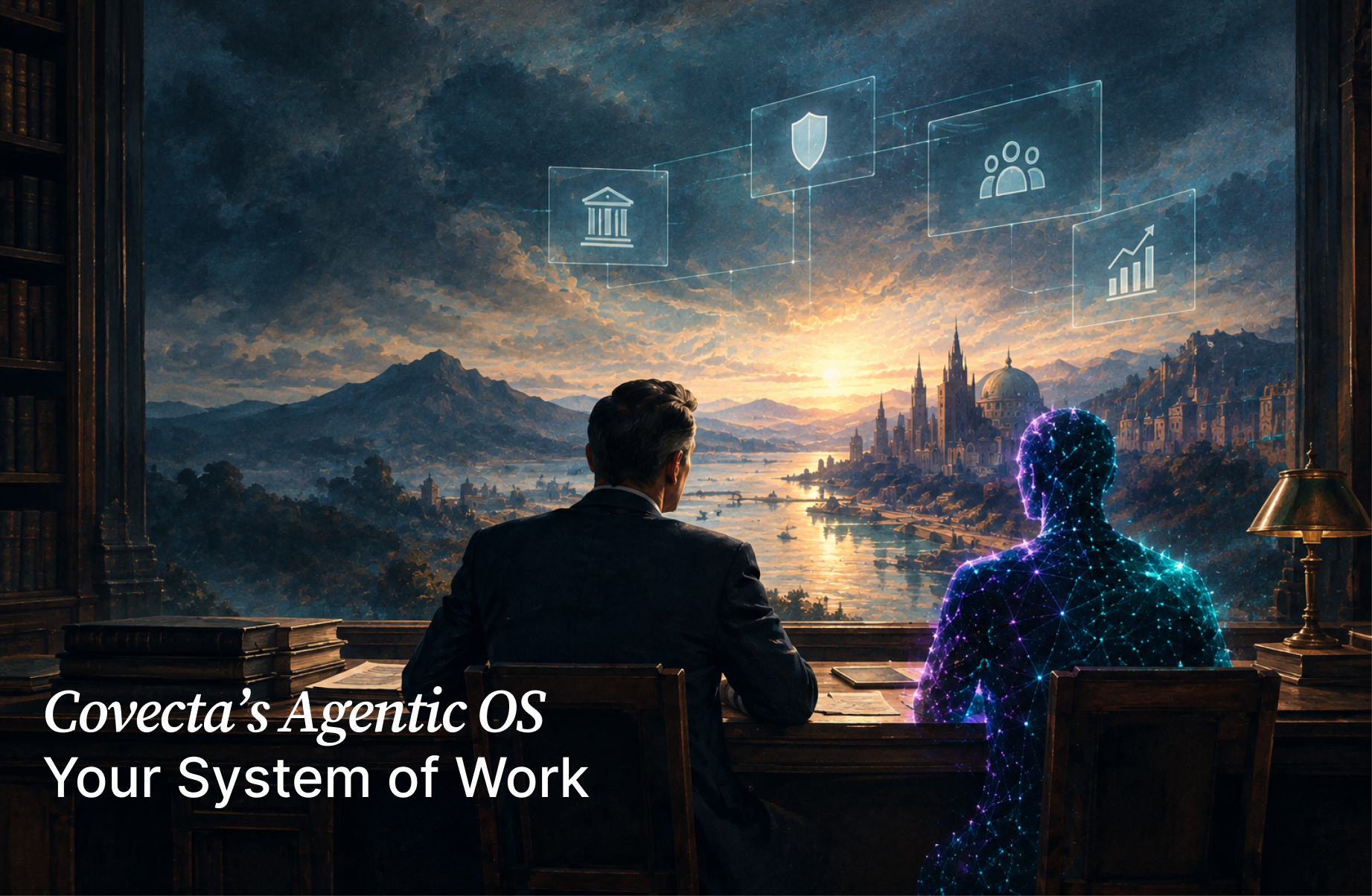
We have reacted to this with a lot of intent. Covecta's Agent OS gives our clients strategic optionality.
You can still deploy our agents exactly as you do today, around the systems you already own. But we are now actively working with our clients to be their full system of work.
The value has moved
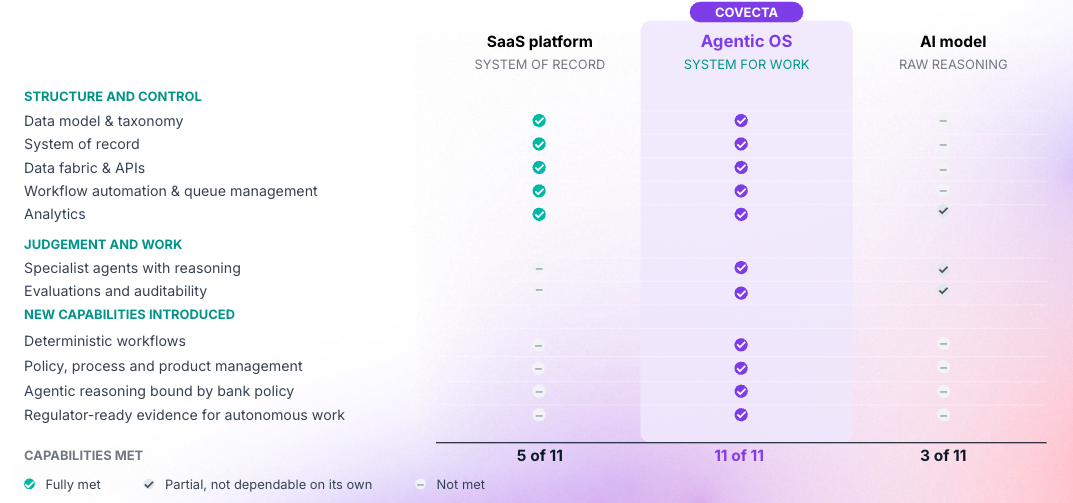
Today's incumbent SaaS providers are fantastic Systems of Record. They give you a data model, a data fabric, workflow automation, analytics and control. That is real and it is not going away.
But the value now accrues where the work is done, not where it is recorded. A raw model brings reasoning and nothing else: no structure, no policy, no evidence trail. An Agent OS is the layer that closes the gap, with deterministic workflows, agentic reasoning bound by bank policy, and regulator-ready evidence for autonomous work.
What this means for our clients
Covecta works with you to transform your business model, extend products and services to your customers, and transform your workforce.
We are going to be a lot more disruptive.